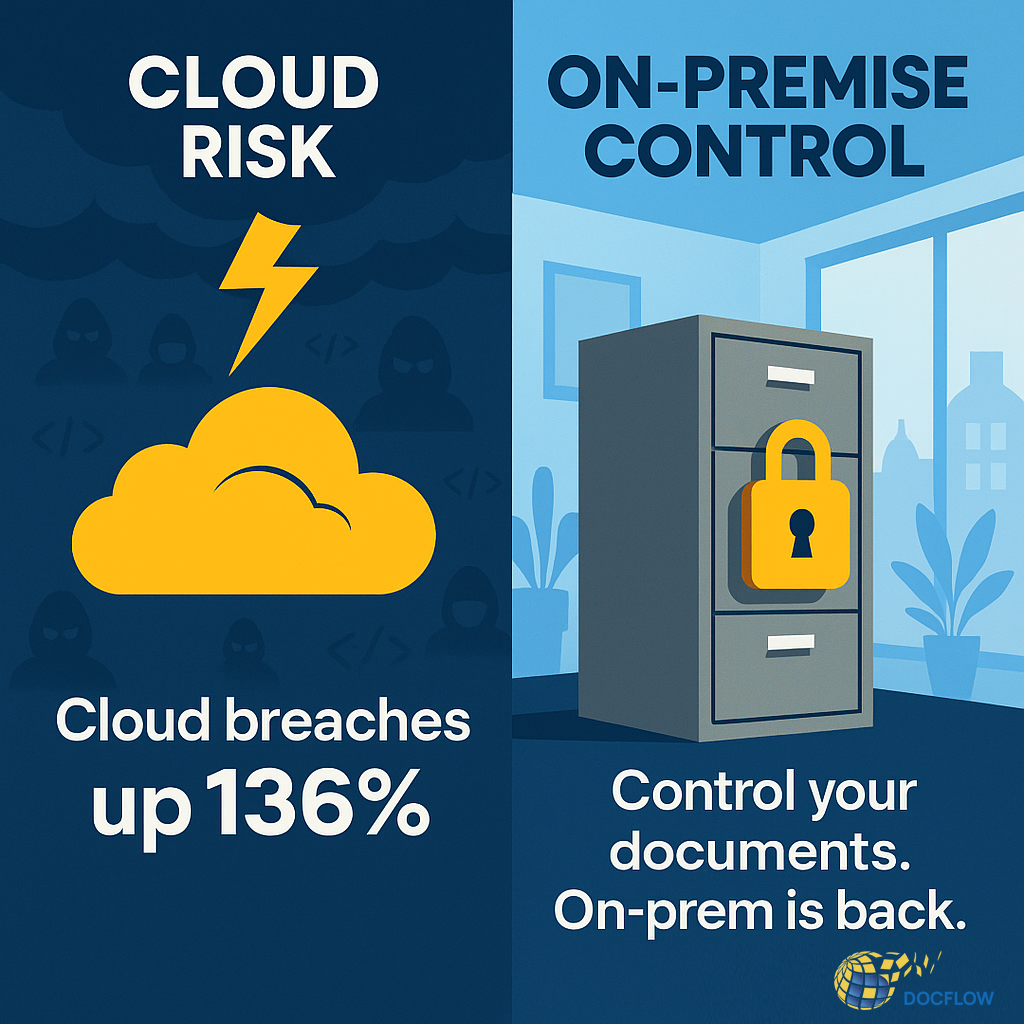
For the past decade, the technology industry has pushed a single narrative: the cloud is the future, and on-premise infrastructure is a relic. For many use cases, cloud computing has delivered on its promises of scalability, convenience, and reduced capital expenditure. But a counter-trend is now firmly underway: organisations are bringing critical workloads back on-premise, and document management is at the centre of that movement.
Why the Pendulum Is Swinging Back
Data Sovereignty
The question "where is my data?" has become one of the most important questions in enterprise technology. When your documents live in a cloud provider's data centre, you are trusting that provider to store your data in the jurisdiction you expect, comply with your national regulations, resist government access requests from other jurisdictions, and maintain the security posture they promised.
For many organisations, particularly those in the legal, defence, healthcare, and public sectors, that level of trust is no longer acceptable. Post-Brexit data adequacy agreements, the evolving Schrems landscape in Europe, and increasing geopolitical tensions have made data sovereignty a board-level concern. On-premise deployment eliminates the ambiguity entirely: your data stays on your servers, in your building, under your control.
Latency and Performance
Cloud document management systems depend on internet connectivity. For organisations with large document volumes, particularly those working with high-resolution scans, engineering drawings, or medical imaging, the latency of cloud access can be a genuine productivity barrier. Uploading, downloading, and searching across thousands of large files is measurably faster when the storage is on the local network.
On-premise deployment puts the data as close to the users as physically possible. In environments where speed matters, such as manufacturing floors, hospital wards, or legal offices working against court deadlines, that proximity translates directly into productivity.
Compliance Requirements
Certain regulatory frameworks impose specific requirements on where and how data is stored. NHS organisations handling patient records, legal firms managing privileged communications, and defence contractors working with classified materials may face explicit prohibitions on storing certain data in shared cloud environments.
On-premise deployment provides the clearest path to demonstrating compliance with these requirements. There is no shared infrastructure, no multi-tenancy, and no reliance on a third party's security certifications. The organisation controls every layer of the stack.
Predictable Costs
Cloud pricing models are designed to scale, and that scaling works in both directions. As your document volumes grow, so do your monthly bills. Storage costs, egress fees, API call charges, and per-user licensing can combine to create costs that are difficult to predict and even harder to control.
On-premise deployment involves upfront capital expenditure, but ongoing costs are predictable. Storage expansion is a one-time hardware purchase, not a recurring monthly charge. For organisations with large, stable document volumes, the total cost of ownership over a five-year period is often lower with on-premise deployment.
The Modern On-Premise Experience
On-premise does not mean going back to the 2000s. Modern on-premise document management, as delivered by DocFlow, provides the same user experience as a cloud deployment:
- Browser-based access. No client software to install. Users access DocFlow through any modern web browser, whether on the local network or remotely via secure reverse proxy.
- Full feature parity. Every feature available in DocFlow's cloud deployment is available on-premise: AIDA AI, workflow automation, version control, audit trails, full-text search, and electronic signatures.
- Automatic updates. Mastercopy provides managed update packages that can be applied during maintenance windows, ensuring your on-premise deployment stays current without disrupting operations.
- Remote access. On-premise does not mean office-only. Secure remote access configurations allow distributed teams to work with the platform from any location, with the same encryption and authentication standards as the cloud version.
When On-Premise Makes Sense
On-premise deployment is not the right choice for every organisation. It is particularly well-suited for:
- Regulated industries with explicit data residency requirements
- Organisations handling sensitive data such as legal privilege, medical records, or classified information
- Large enterprises with existing data centre infrastructure and IT teams capable of managing the deployment
- Organisations with high document volumes where cloud egress and storage costs become significant
- Environments with unreliable internet connectivity where cloud dependency would create operational risk
DocFlow's Self-Hosted Model
DocFlow is designed from the ground up to support both cloud and on-premise deployment. The on-premise version runs on standard server infrastructure and can be deployed on physical hardware or virtualised environments. Mastercopy provides full deployment support, including:
- Infrastructure specification and sizing guidance
- Installation and configuration
- Data migration from existing systems
- Staff training
- Ongoing technical support and maintenance
Critically, organisations choosing on-premise do not sacrifice AI capabilities. AIDA runs locally on your infrastructure, processing documents without sending data to external services. Your documents never leave your servers, even during AI processing.
The Hybrid Option
Some organisations opt for a hybrid approach: sensitive documents on-premise, less critical content in the cloud. DocFlow supports this model, allowing organisations to define policies that determine where documents are stored based on classification, sensitivity level, or department. This provides the flexibility of cloud with the control of on-premise, applied selectively where it matters most.
The cloud-only era is over. The future is choice, and the smart choice depends on your data, your regulations, and your risk appetite. DocFlow gives you that choice without compromise.